
Trenchless Sewer Line Repair
Repair your sewer line without digging up your yard. Septiclear Inc delivers professional trenchless sewer line repair for residential, commercial, and municipal properties across Oregon. Call (503) 542-9660 to schedule a free camera inspection.
Full System Inspection Every Visit
We check baffles, walls, and drain field signs – not just pump and leave
Emergency & Scheduled Service
Same-day emergency response for residential, commercial, and industrial
Written Report After Every Job
Compliant Effluent Disposal
Hauled and disposed at state-approved facilities – groundwater protected
Prompt Arrival Windows
Vetted Local Partners Statewide
All 36 Oregon counties covered through licensed local service partners
5 Highlights on Trenchless Sewer Line Repair
Minimal disruption
Trenchless sewer line repair replaces, reseals, or relines your pipe from within – preserving your landscaping, driveway, and structure without the wide-scale excavation and restoration costs of traditional open-cut repair.
Two proven methods: CIPP lining and pipe bursting
Cured-in-place pipe lining seals deteriorated or cracked pipes from the inside. Pipe bursting replaces a failed lateral entirely without a trench. We assess your system and recommend the right method for your specific pipe condition, diameter, and material.
Full CCTV inspection before and after
Every trenchless sewer repair begins with a camera scope to confirm pipe condition, identify blockage locations, and log slope and invert elevation data. After repair, we scope again to confirm full seal and structural integrity.
Works on all pipe materials
We reline or burst PVC, cast iron, clay, concrete, Orangeburg, and damaged host pipes across residential, commercial, and municipal systems.
Written workmanship guarantee
Septiclear Inc backs every trenchless sewer repair with a written guarantee covering the liner and installation. CIPP liners installed to ASTM F1216 standards are rated for 50+ years of service life.
Across Oregon since founding
Trusted in the Pacific Northwest
All Oregon health & env. codes
Need service today? We're ready.
Call now for same-day emergency pumping or schedule your next routine visit.
Why Choose Our Trenchless Sewer Line Repair
Septiclear Inc has been performing trenchless sewer line repairs across Oregon since 2012, serving residential, commercial, and municipal properties in Multnomah, Clackamas, Washington, Yamhill, Columbia, and Marion counties. Our crews bring professional-grade equipment, certified technicians, and documented repair processes to every sewer line project – from single-family laterals to commercial mainlines.
We don’t guess at pipe conditions. We scope first. Every trenchless repair project begins with a CCTV camera inspection that maps the full length of the pipe, logs the invert elevation and slope, identifies cracks or joint separations, and records the location and depth of every access point needed. That scope determines the repair method – CIPP relining, pipe bursting, or a combination of both.
Our crew holds NASSCO PACP/MACP certification for pipeline assessment and condition grading, with specific training in CIPP installation, pipe bursting, and hydro-jetting. In Oregon’s Willamette Valley, clay-heavy soils and high seasonal groundwater can affect liner cure times and resin selection – our technicians account for those conditions on every job. We carry full liability insurance and equipment capable of handling pipes from 3 inches to 36 inches in diameter across clay-based, sandy, loamy, and compacted soil conditions.
We own our equipment. We don’t subcontract camera inspection, lining, or bursting to third-party crews. That means quality control stays in our hands from the first scope to the final inspection footage.
We pull the required permits, coordinate with local inspectors, and provide documented camera footage – both pre-repair and post-repair – with timestamps, pipe material notations, and condition ratings that satisfy property records and insurance documentation requirements.
Our trenchless work is led by Ryan Lear, an Oregon DEQ-certified septic contractor with NASSCO PACP certification. Our team is also certified through the National Association of Wastewater Technicians (NAWT). Call (503) 542-9660 to schedule your free camera inspection.
Certified, Insured & Compliant - Every Job, Every Time
State Licensed
Fully licensed by Oregon health & DEQ
Fully Insured
Liability & workers’ comp coverage
Approved Disposal
Licensed effluent disposal facilities only
Written Reports
Documented service record after every job
DEQ Compliant
Full Oregon environmental code compliance
Signs You Need Trenchless Sewer Line Repair
Recurring sewage backups:
When sewage backs up through floor drains, toilets, or tubs repeatedly – especially after clearing a clog that returns within days or weeks – the pipe itself is failing. A collapsed section, root intrusion through a cracked joint, or a displaced pipe segment allows solids to accumulate faster than normal cleaning can clear them.
Sinkhole or wet spot in the yard:
A soft spot, depression, or soggy area above a sewer lateral often means the pipe has failed at that point, allowing effluent to saturate the surrounding soil. The soil voids form as displaced soil washes away through the pipe break.
Slow drains throughout the property:
Slow drains in every fixture – not just one sink or toilet – point to an obstruction or restriction in the main sewer line between the building and the public main or septic system. Biomat, root growth, or a collapsing pipe wall all create this symptom.
Foul odors from drains or around the foundation:
Hydrogen sulfide and sewer gases escape from cracked pipes before they reach the vent stack. Persistent sewer odors near floor drains, in the crawl space, or along the building’s exterior can indicate a fractured pipe in the slab or subsoil.
Lush or unusually green grass strips in the yard:
Nitrogen-rich effluent from a cracked or leaking sewer lateral fertilizes the soil directly above. A visibly greener, faster-growing strip of lawn directly above the pipe route is a clear signal of an underground leak.
Is It Time to Pump Your Tank?
Our Trenchless Sewer Line Repair Process
Pre-Repair Camera Inspection
We insert a push camera or crawler camera into the lateral through an existing cleanout, manhole, or access port. We log the pipe material, diameter, joint condition, crack location, invert elevation and slope, and the position of any root intrusions or displaced sections. This footage determines the repair method, equipment, and liner specs.
Hydro-Jetting and Pipe Preparation
Before any liner is installed, we clean the pipe interior with a high-pressure hydro-jetter, removing scale, biomat, root tendrils, and accumulated debris. A clean pipe surface is critical for proper liner adhesion and full-circumference bonding. We verify the interior is clean and dry with a secondary pass of the camera.
CIPP Lining or Pipe Bursting
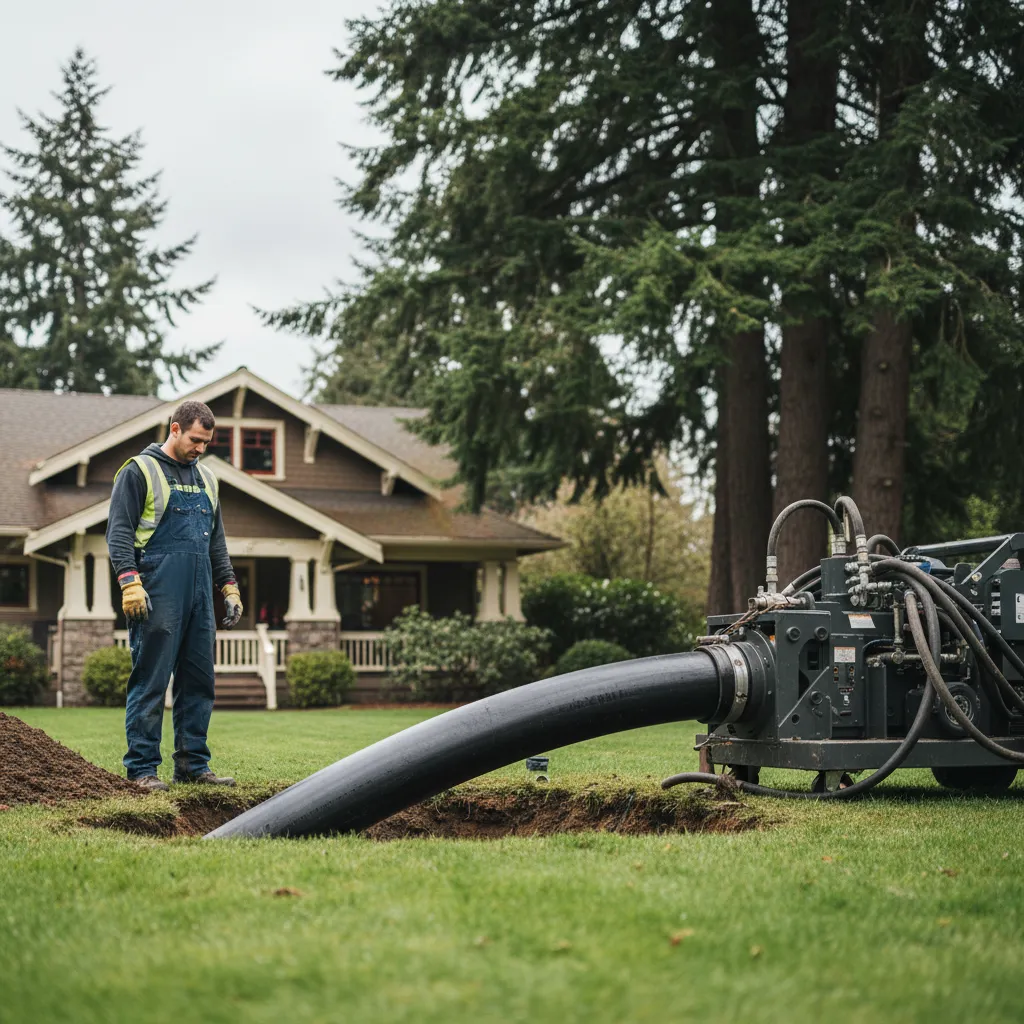
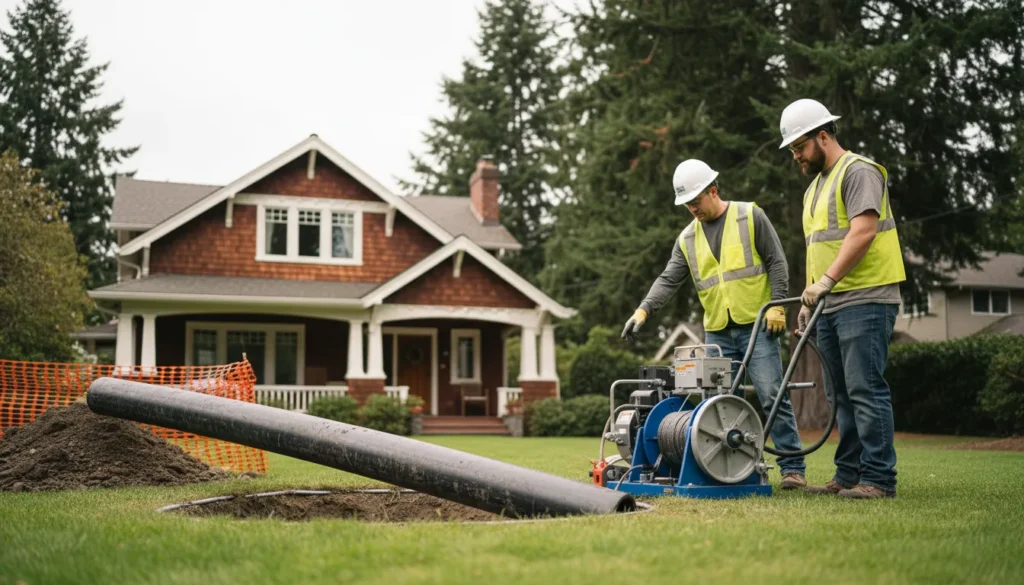
For CIPP: we insert a felt or fiberglass liner saturated with epoxy or polyester resin, position it to span the repair zone, and cure it using hot water, steam, or UV light depending on the resin system. The cured liner bonds to the pipe interior and creates a structural, seamless tube with a 50+ year design life. For pipe bursting: we pull a bursting head through the failed pipe, fragmenting the host pipe outward and simultaneously pulling a new HDPE or PVC pipe into position. Unless a specific access point genuinely requires it, we avoid digging entirely.
Post-Repair Camera Verification
After lining or bursting is complete, we run the camera through the repaired section to confirm full liner coverage, proper joint terminations, no wrinkles or voids, and correct pipe alignment. All footage is timestamped and exported for your records.
Permit Documentation and Final Report
We compile the pre-repair scope, post-repair scope, repair method documentation, and any required permit certificates into a complete file. You receive a copy for your property records, insurance files, or any future real estate documentation needs.
Never Miss a Pump Date Again
We offer annual and biannual scheduled pumping plans for residential and commercial customers – set it once, stay consistently maintained.
Brands We Use
Septiclear Inc uses professional-grade trenchless repair equipment and lining systems from trusted industry manufacturers:







Equipment and liner materials are selected based on pipe diameter, material, and site conditions.
Other Services
Trenchless sewer line repair
CIPP lining service
Pipe bursting Oregon
Sewer line repair without digging
No dig sewer repair
Sewer lateral relining
Trenchless pipe repair
Trenchless sewer rehabilitation
Sewer pipe lining service
Residential trenchless sewer repair
Home sewer line repair no dig
Root intrusion sewer repair
Trenchless sewer line repair cost
Affordable trenchless sewer repair
Trenchless plumbing solution
Save money reduce labor costs restore water flow
Sewage system repair
Trenchless drain pipe repair
Ready to schedule your service?
Prompt arrival windows, transparent pricing, no surprise fees – guaranteed.
FAQs About Trenchless Sewer Line Repair
What is trenchless sewer line repair?
Trenchless sewer line repair is a pipe rehabilitation method that restores a failed or deteriorating sewer line from inside the pipe, without excavating a trench along the full length of the lateral. The two main methods are CIPP (cured-in-place pipe) lining, which seals the existing pipe from within, and pipe bursting, which replaces the pipe entirely while pulling a new one into place through the same path.
When do you need trenchless sewer repair instead of traditional excavation?
Trenchless repair is appropriate when the pipe has structural failures (cracks, joint separations, collapsed sections) that can’t be cleared by jetting alone, but the surrounding soil isn’t yet significantly disturbed and the pipe alignment is still essentially intact. It’s especially valuable under driveways, landscaped yards, foundations, and slab floors where open excavation would be extremely disruptive.
What's the difference between CIPP lining and pipe bursting?
CIPP lining installs a resin-saturated liner inside the existing pipe and cures it in place, creating a structural tube bonded to the interior wall. This works when the host pipe still has acceptable alignment and enough clearance to receive the liner. Pipe bursting fragments the failed host pipe outward and simultaneously pulls a new pipe into the same trench, replacing the original pipe rather than sealing it. Pipe bursting works when the existing pipe has severely deteriorated and can’t support a liner.
How long does a CIPP liner last?
CIPP liners installed to ASTM F1216 standards are rated for 50+ years of service life. The liner creates a structural, corrosion-resistant tube that is not affected by root intrusion, hydrogen sulfide corrosion, or soil movement that would otherwise continue degrading a clay, concrete, or Orangeburg pipe.
How much does trenchless sewer line repair cost?
Trenchless sewer repair in Oregon typically ranges from $3,500 to $12,000 depending on pipe length, diameter, access conditions, repair method (CIPP vs. pipe bursting), and local permit fees. CIPP lining for a standard residential lateral generally runs $100 to $250 per linear foot. Pipe bursting tends to cost more due to equipment setup. A scoped inspection is the most accurate way to determine cost for your specific job. We provide a written estimate after the camera assessment.
Does trenchless repair require any digging at all?
Minimal access is typically needed – an existing cleanout, a manhole opening, or a small pit at each end of the liner run. We don’t dig a full trench along the pipe route. For residential laterals with accessible cleanouts, most jobs require no new excavation at all.
What credentials do Septiclear Inc technicians hold for this work?
Our technicians hold NASSCO PACP/MACP certification for pipeline condition assessment and grading, with specific training in CIPP installation, pipe bursting, and hydro-jetting. We carry Oregon CCB licensing and maintain full liability insurance. All trenchless repair work is led by a licensed contractor.
How do I get started?
Call (503) 542-9660 to schedule a free camera inspection. We’ll scope the pipe, identify the failure type and location, and give you a written repair recommendation with full cost disclosure before any work begins.
Ready to Work With Us?
We’d love to hear from you. Whether you need routine service, a system inspection, or emergency help today, our team is ready.